Canning pears safely: why Asian pears need added acid
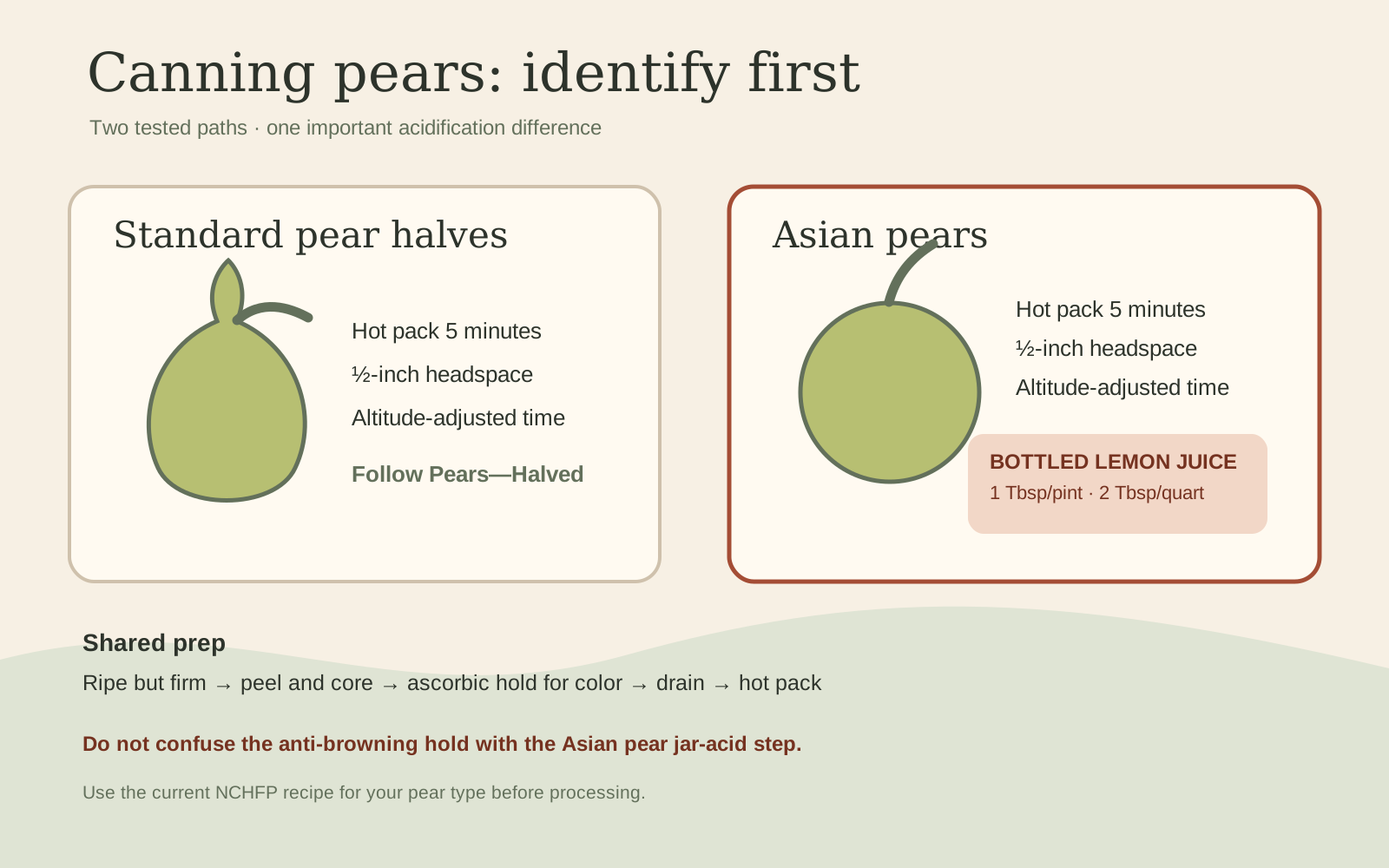
Standard pear halves and Asian pears share much of the same hot-pack workflow, but they are not the same canning process. Asian pears need measured bottled lemon juice in every jar before boiling-water processing.
The safety decision comes before the syrup
A box of pears can look like one preserving project, but pear type changes a critical instruction. The National Center for Home Food Preservation publishes one process for standard pear halves and a separate acidified process for Asian pears. Oregon State University Extension explains that Asian pears require acidification before canning because their natural acidity varies. The added acid is a safety control, not a flavor option.
Common European-type pears often develop the familiar tapered neck and soften as they ripen. Asian pear cultivars are frequently round and crisp, but shape and texture are not a reliable home test for acidity. Market labels, orchard records, or a cultivar identification from a knowledgeable grower are better evidence. If a mixed box cannot be identified, do not guess which process applies.
The two current NCHFP pages happen to list the same boiling-water times. That does not make the recipes interchangeable. The Asian pear process includes a measured jar-acidification step that the standard pear-halves process does not. Follow the full page written for your fruit.
Choose ripe, firm fruit
Pears intended for canning should be mature and good quality. Many standard pears ripen best after harvest. Oregon State University Extension suggests holding them in a cool place and checking daily near the stem. For canning, use them while they are ripe but still firmer than fruit you would choose for soft eating. Overripe fruit breaks down during heating and is harder to peel and pack neatly.
Reject moldy, fermented, badly bruised, or decayed fruit rather than trimming questionable areas into a canning batch. Wash sound pears under clean running water. Do not use soap or produce wash. Clean hands, work surfaces, utensils, jars, and canning equipment before the first cut.
NCHFP's average planning quantities are about 17½ pounds of standard pears for a seven-quart canner load and about 11 pounds for nine pints. Asian pears vary more in the published estimates: about 17 to 19 pounds for seven quarts or 11 to 13 pounds for nine pints. These are shopping estimates, not batch-size targets. Actual yield changes with cultivar, size, trim loss, and pack density.
Peel, core, and control browning
Wash, peel, halve lengthwise, and remove the cores. The Asian pear process also allows slices. As pieces are prepared, hold them in an ascorbic-acid solution to reduce browning. A commercial anti-darkening product can be used according to its label and the tested recipe.
This holding solution serves quality, not the required Asian pear safety step. It keeps cut surfaces from darkening while the rest of the batch is prepared. It does not replace the bottled lemon juice measured into each Asian pear jar. Keep those two actions separate on the work plan: anti-darkening solution for cut fruit, then bottled lemon juice for every filled Asian pear jar.
Drain the pears before the hot-pack step. Do not carry an unknown amount of holding solution into the canning liquid, and do not treat a long soak as extra insurance. The tested process controls the form of the fruit, heating, packing liquid, headspace, jar acid where required, and canner time together.
Select a tested packing liquid
Both NCHFP pear processes allow very light, light, or medium syrup, as well as water, apple juice, or white grape juice. Syrup helps canned fruit retain flavor, color, and shape, but it is not what makes plain pears safe. Choose among the published liquids based on the flavor and added sugar you want, then keep the rest of the process unchanged.
A very light syrup can approximate the natural sugar level of many fruits; a heavier allowed syrup supports texture and sweetness. Water produces a plainer jar and may lead to more flavor loss. Apple or white grape juice adds its own flavor. Do not substitute unlisted juices, alcohol, flavored drinks, plant milks, or sugar substitutes into this process without a current tested recipe that names them.
Prepare enough liquid to cover the fruit while respecting the final half-inch headspace. Extra liquid is preferable to stretching a short batch with an improvised ingredient. Keep the packing liquid hot, and avoid letting a filled jar wait on the counter while the rest of the fruit is cooked.
Use the five-minute hot pack
Add the drained pears to the selected boiling packing liquid and boil gently for five minutes. Pack the hot fruit into hot jars, then cover it with the hot liquid. NCHFP notes that raw packs make poor-quality pears; the hot pack removes air from the fruit, helps it settle into the jar, and improves the finished pack.
Leave ½-inch headspace. Slide a suitable bubble remover around the inside of the jar, then recheck and adjust the headspace. Wipe the rim so fruit fibers or syrup do not interfere with the seal. Center the lid and apply the band according to the lid manufacturer's current directions. Overtightening can prevent air from escaping during processing.
Use pint or quart canning jars because those are the sizes listed in the current NCHFP tables. Do not use a larger jar and borrow the quart time. A smaller decorative jar also needs a tested process; size alone does not establish one.
Asian pears need acid in every jar
For Asian pears, put bottled lemon juice into each jar: 1 tablespoon per pint or 2 tablespoons per quart. The NCHFP direction calls for bottled lemon juice because it provides standardized acidity. Fresh lemons vary, so fresh juice is not a measured substitute in this process.
A simple way to avoid a missed jar is to line up the empty hot jars, measure bottled lemon juice into each one, and then move the acid bottle away before filling. Count the prepared jars against the expected load. If the yield changes, prepare any additional jar individually before it receives fruit.
Do not reduce the acid because the packing liquid is tart, because the cultivar tastes sharp, or because an anti-darkening solution was used. Taste cannot measure pH, and the holding solution was not dosed as the jar safety control. Penn State Extension's acidification guidance advises against changing or diluting the prescribed acid unless the tested recipe expressly allows it.
The current plain standard pear-halves process does not direct this jar-acidification step. That narrow distinction applies to these two published plain-fruit recipes; it is not a rule for every pear preserve. Pickles, relishes, butters, and mixed-fruit recipes have their own formulas and cannot borrow the plain pear process.
Adjust boiling-water time for elevation
Place filled jars in a boiling-water canner using the current tested procedure. Water boils at a lower temperature as elevation rises, so the published process adds time by elevation band. Use the elevation of the kitchen where the canner is operating, not a town average or a nearby valley.
| Elevation | Pints | Quarts |
|---|---|---|
| 0–1,000 feet | 20 minutes | 25 minutes |
| 1,001–3,000 feet | 25 minutes | 30 minutes |
| 3,001–6,000 feet | 30 minutes | 35 minutes |
| Above 6,000 feet | 35 minutes | 40 minutes |
These times summarize the current NCHFP boiling-water tables for both standard pear halves and acidified Asian pears. Start timing only when the canner has returned to the required boil. Maintain the condition for the entire adjusted time. If the boil stops, follow the current NCHFP directions for an interrupted process rather than adding a guessed correction.
Our altitude guide explains why time changes and how to find a reliable kitchen elevation. Mark the jar size and elevation band on your batch record before filling. That small step prevents a last-minute choice while steam and hot jars are competing for attention.
Cool, check, and store the jars
When the process ends, follow the tested canner shutdown and removal directions. Keep jars upright and set them where air can circulate. Leave them undisturbed during the recommended cooling period. Do not retighten bands, press lids, or tip hot jars to investigate bubbles or liquid loss.
After the jars are fully cool, check each seal, remove the screw band, wash residue from the jar if needed, and label the product and date. Store sound jars in a cool, dry, dark place. Our seal and storage guide covers seal checks, band removal, and warning signs that mean a jar should not be tasted.
Floating fruit, a pink cast, or some darkening can be quality problems without proving that a jar is unsafe. The reverse is also true: clear liquid and a firm lid do not prove the correct recipe was followed. Safety depends on the documented process. If acid was missed in an Asian pear jar, the processing time was short, or the jar size was unlisted, do not place the jar on a pantry shelf based on appearance.
Do not move Asian pears into another pear recipe by default
Oregon State University Extension cautions that Asian pears cannot generally replace European pears or apples in canning recipes. A few specific tested recipes contain enough acid for the substitution, but that permission belongs to those named formulas. It does not extend to an arbitrary pear butter, salsa, chutney, conserve, or mixed-fruit jar.
If you want a product beyond plain canned fruit, find a current tested recipe that explicitly includes Asian pears or expressly permits the substitution. Then follow that complete formula. Do not add lemon juice to a favorite untested recipe and assume the jar is validated; acidity is only one part of heat penetration and product safety.
This is where the site's tested-recipe guide is useful. Check the source, exact produce, preparation, ingredient proportions, jar size, headspace, method, processing time, and elevation adjustment as one package.
Write a batch record that catches the mix-ups
Record the cultivar or market label, recipe URL, date accessed, packing liquid, jar sizes, kitchen elevation, and required time. For Asian pears, add a checkbox beside every jar for the bottled lemon juice dose. Note actual yield, seal results, siphoning, and quality after cooling.
A batch record is especially useful when two pear types are in the kitchen at once. Keep them in labeled containers and finish one tested process before starting the other. Separate utensils are less important than a clear sequence, but separate work trays can prevent prepared Asian pears from being packed under the standard pear plan.
Next season, those notes help you choose ripeness, syrup strength, slice size, and batch quantity without changing the safety controls. Good records turn quality observations into useful improvements while the tested method stays intact.
Sources checked
- National Center for Home Food Preservation: Pears—Halved
- National Center for Home Food Preservation: Asian Pears
- Oregon State University Extension: Preserving Asian Pears
- Oregon State University Extension: Preserving Pears
- Penn State Extension: Let's Preserve: Pears
- Penn State Extension: Acidifying Canned Products for Safety
Reviewed October 21, 2026. Reopen the current tested recipe before processing because source pages and recommendations can change.
Community discussion
Discuss this guide
Share what you tried, what changed, or a focused question. Replies are reviewed before they appear so unsafe advice, spam, and personal information stay out of the discussion.
Loading approved notes…