Canning apple butter safely: stay inside the tested formula
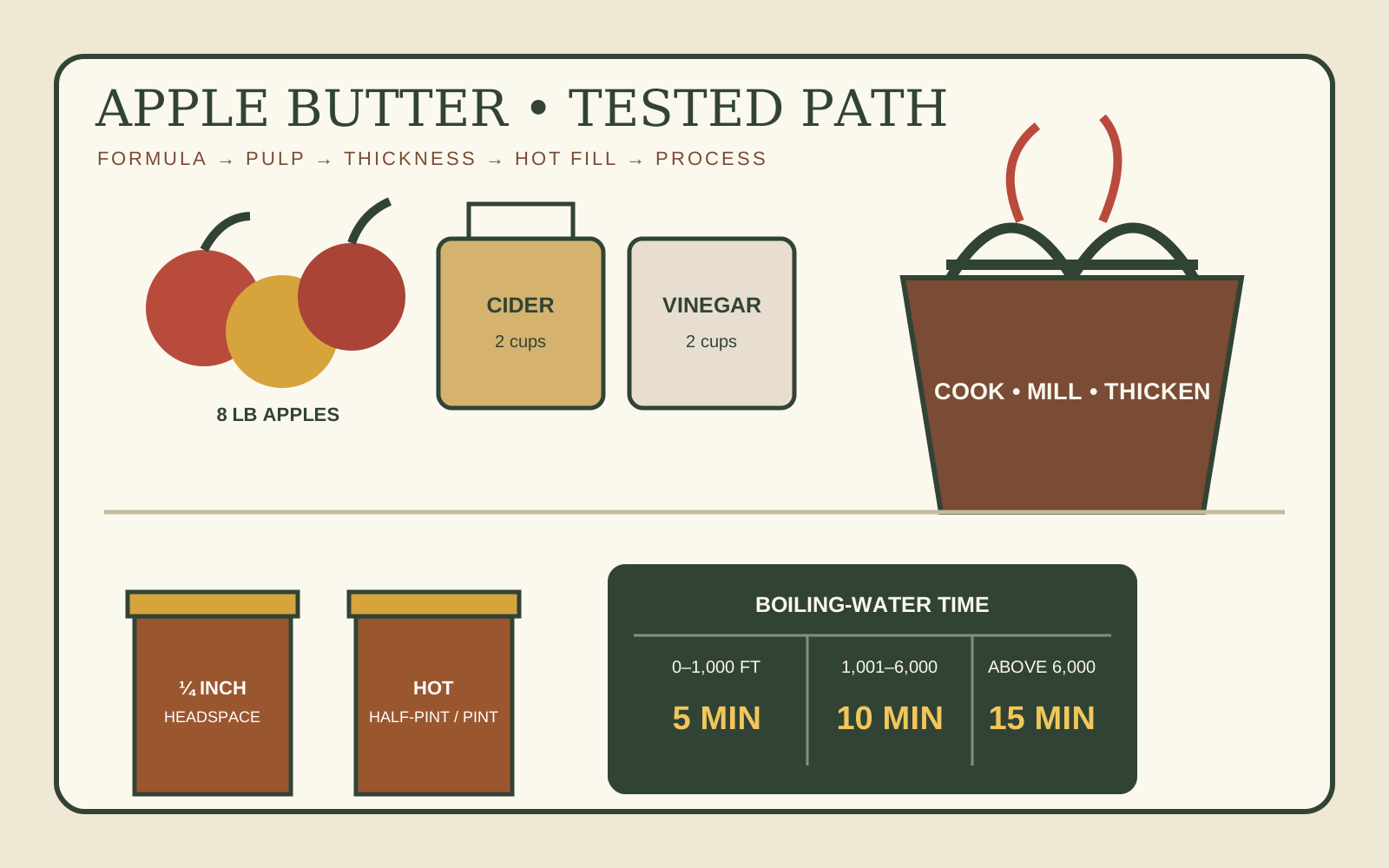
Apple butter is concentrated fruit, not applesauce with a longer cook. The tested NCHFP formula fixes the apples, cider, vinegar, sugars, spices, hot fill, ¼-inch headspace, jar options and altitude-adjusted process as one method.
Start with the exact tested product
Apple butter is made by cooking seasoned apple pulp until it becomes a thick, spreadable fruit butter. The National Center for Home Food Preservation publishes a specific tested formula: 8 pounds of apples, 2 cups apple cider, 2 cups vinegar, 2¼ cups white sugar, 2¼ cups packed brown sugar, 2 tablespoons ground cinnamon and 1 tablespoon ground cloves. Its listed yield is about 9 to 10 pints.
Those quantities are not a menu of independent suggestions. They describe the product for which the preparation and boiling-water process were published. Changing the fruit, acid, sugar, texture or concentration can change the way the product heats and stores. The safe shortcut is to choose a tested recipe that already matches the product you want rather than redesigning one during the cook.
NCHFP suggests Jonathan, Winesap, Stayman, Golden Delicious, McIntosh or other flavorful apple varieties. A blend can create a more interesting flavor, but the batch remains eight pounds of apples in the standard formula. Use sound fruit, wash it, remove stems, quarter and core it as directed. The standard procedure does not instruct you to add pumpkin, pear, maple syrup, dairy, caramel, nuts or other low-acid or untested additions.
Why cider and vinegar both belong
The tested formula cooks the quartered, cored apples slowly in both cider and vinegar until soft. Cider contributes apple flavor and cooking liquid. Vinegar is part of the published acid balance. Do not omit it, reduce it, replace it with water, or guess at a milder amount because the finished spread tastes tart before the sugar and concentration settle in.
Use the cider and vinegar amounts listed by the source. “Apple cider” in this context is not interchangeable with a flavored drink, hard cider, cider syrup or an unverified homemade ferment. If a product label is unclear, select a straightforward ingredient that matches the tested wording or ask an Extension food-preservation specialist.
Public canning discussions often ask whether bottled lemon juice can replace vinegar or whether apple juice can replace cider. A general substitution rule cannot validate this formula. Even when two ingredients sound similarly acidic or apple-based, their composition and role may differ. Follow the listed ingredients unless the tested source itself publishes an alternative.
Make pulp before you add sugar and spices
The apples first cook in cider and vinegar until soft. The softened fruit then goes through a colander, food mill or strainer. That sequence produces the pulp specified by the recipe and removes coarse material before concentration. A high-powered blender can incorporate air and produce a different texture; do not swap equipment merely because it makes a smooth purée quickly.
Only after the pulp is prepared does the standard recipe add the white sugar, packed brown sugar and ground spices. Measure packed brown sugar as stated. Keep tablespoons and teaspoons distinct. A missed unit in a large batch creates a very different spread.
Use a wide, heavy, nonreactive pot with enough room for safe stirring and bubbling. Penn State Extension recommends stainless steel rather than unlined or questionable copper cookware for apple butter because acid can react with copper. Avoid decorative kettles or pots with damaged linings. Use heat-resistant utensils and protect against splashes; thick fruit spreads can spit as steam escapes.
Do not treat sugar like the optional sugar in applesauce
The site's tested applesauce guide explains that NCHFP allows sugar to taste in that applesauce process. That flexibility does not transfer to apple butter. Fruit butters are concentrated spreads, and sugar can affect solids, texture, flavor and the behavior of the tested product.
If you want less sugar, NCHFP has a separate research-based reduced-sugar apple butter formula. It uses its own ingredients and a 15-minute boiling-water process at 0 to 1,000 feet, increasing to 20 minutes at 1,001 to 6,000 feet and 25 minutes above 6,000 feet for half-pint or pint jars. Those times are not interchangeable with the standard recipe's five-, ten- and fifteen-minute table.
Choose one complete recipe. Do not take the lower sugar from the reduced-sugar formula and the shorter time from the standard formula. Likewise, do not replace sugar with honey, maple syrup, stevia or another sweetener unless a current tested source explicitly provides that version. Anyone preserving for a therapeutic diet should select an appropriate tested formula with a clinician or dietitian rather than improvising a shelf-stable spread.
Use both published doneness tests
Apple butter is ready for filling only after adequate concentration. NCHFP gives two visual tests. In the spoon test, remove a spoonful, hold it away from steam for two minutes, and look for the butter to remain mounded. In the plate test, spoon a small amount onto a plate; it is ready when liquid does not separate into a rim around the butter.
These tests are more useful than a clock alone. Apple variety, initial moisture, pot shape, batch size and heat level change evaporation time. A slow cooker may take many hours, while a wide stovetop pan can reduce faster. Oregon State University Extension describes a slow-cooker option for tested fruit-butter formulas, with the lid ajar and occasional stirring, but that changes only the cooking equipment. It does not authorize a new ingredient formula or eliminate the final canner process.
Stir more often as the pulp thickens. Scrape across the bottom and into corners where scorching begins. Burned flavor will not disappear in the jar, and a scorched batch is not improved by processing. Reduce heat rather than leaving a thickening spread unattended.
Prepare jars for the actual process time
The standard NCHFP recipe calls for hot apple butter in sterile half-pint or pint jars, with ¼-inch headspace. NCHFP's general jar guidance requires presterilizing empty jars when the filled-jar process is less than 10 minutes. At 0 to 1,000 feet, the standard half-pint or pint apple butter process is five minutes, so jar sterilization is part of the plan.
At higher elevations, the listed process becomes 10 or 15 minutes. Follow the recipe's jar instructions and current NCHFP guidance together rather than assuming an altitude change gives permission to ignore preparation details. Keep jars hot until filling to reduce thermal shock and maintain the hot-pack process.
Fill the apple butter hot and measure ¼-inch headspace. Remove trapped air as appropriate, adjust headspace, clean the rim and apply lids according to their current manufacturer instructions. Use standard home-canning jars in a size listed by the tested recipe. Decorative jars, reused commercial jars and larger unlisted sizes do not gain a safe process from looking similar.
| Elevation | Half-pint or pint time | Planning note |
|---|---|---|
| 0–1,000 feet | 5 minutes | Use sterile jars because the process is under 10 minutes |
| 1,001–6,000 feet | 10 minutes | Match the kitchen elevation to this band |
| Above 6,000 feet | 15 minutes | Use the highest listed band |
This table summarizes the current standard NCHFP apple butter process for half-pints and pints. Reopen the live source before canning in case guidance changes. The same page also lists quart jars with different processing times, but smaller jars are easier to use as a spread and reduce the temptation to invent a process for an in-between or oversized container.
Altitude is a measured input
Water boils at a lower temperature as elevation rises. A boiling-water process compensates with added time. Find the elevation of the kitchen where the canner will operate, not a general regional elevation, and mark the applicable band before fruit preparation begins.
Our canning altitude guide explains how the adjustment works and where to find elevation data. If your address sits near a boundary, use an authoritative elevation source rather than guessing. Never shorten the time because the product is already hot or because the lids sealed quickly.
Start timing only when the canner returns to the full condition required by the tested boiling-water procedure. Maintain the process for the entire adjusted time. If the boil is interrupted, follow the current NCHFP instructions for handling that interruption rather than adding an improvised minute or two.
Open-kettle sealing is still not processing
Apple butter is hot and thick enough to make an unprocessed jar lid pull down as it cools. That “pop” is not proof of a safe process. Penn State Extension's March 2026 guidance explains that open-kettle canning—filling hot food, applying lids and stopping—is not recommended because it may not adequately destroy spoilage organisms introduced during filling and may not create a dependable seal.
Process every jar using the tested method, even when the apple butter has cooked for hours. The long concentration step and the final jar process do different jobs. Oven canning, dishwasher processing, turning jars upside down and wrapping hot jars in blankets are not substitutes.
Cool, check and store without tightening bands
After the full process, follow current canner guidance for shutdown and jar removal. Place jars upright where air can circulate, and leave them undisturbed for the recommended cooling period. Do not press lids, retighten bands or tip jars to inspect them while they are hot.
When completely cool, check the seal, remove screw bands, wash residue if needed, label the product and date, and store sound jars in a cool, dry, dark place. The seal and storage guide explains why bands come off and which warning signs mean a jar should not be tasted.
Refrigerate apple butter after opening. Refrigerate a jar that did not seal only when the tested guidance says it is within the safe handling window, or promptly reprocess according to current instructions with the quality tradeoff understood. A seal does not rescue the wrong recipe, wrong jar size, missed acid or inadequate process.
Know which “butters” have no tested canning path
The word butter describes texture, not a universal canning category. Oregon State University Extension warns that there are no safe research-based home-canning recipes for butters made from Asian pears, figs, pumpkin, melons or mangoes. Those products belong in the refrigerator for short storage or the freezer for longer storage unless a current tested source provides an exact method.
This matters in fall kitchens where pumpkin butter and mixed apple-pumpkin spreads circulate widely online. The site's pumpkin and winter squash guide explains why tested canning directions cover one-inch cubes, not purée or butter. Do not blend a tested apple butter with pumpkin and keep the apple butter time.
Build a batch record before the first cut
Write the source URL and date accessed, selected standard or reduced-sugar formula, apple varieties, ingredient amounts, jar size, kitchen elevation, required jar preparation and processing time. During the cook, record actual yield and which doneness test passed. After cooling, note seal results, siphoning and quality observations.
This record makes future improvement possible without changing safety controls. You can choose a more aromatic apple blend, use a wider suitable pot, stir more often or make a smaller batch while keeping the tested formula and process intact. You can also compare the standard and separately tested reduced-sugar recipe as two documented products rather than a series of improvised halfway versions.
Sources checked
- National Center for Home Food Preservation: Apple Butter
- National Center for Home Food Preservation: Reduced Sugar Apple Butter
- Oregon State University Extension: Fruit Butters
- Penn State Extension: Preserving the Amazing Apple
- Penn State Extension: Avoid Open Kettle or Oven Canning
- National Center for Home Food Preservation: Sterilization of Empty Jars
Reviewed October 15, 2026. Always reopen the current tested recipe before processing; recommendations and source pages can be revised.
Community discussion
Discuss this guide
Share what you tried, what changed, or a focused question. Replies are reviewed before they appear so unsafe advice, spam, and personal information stay out of the discussion.
Loading approved notes…